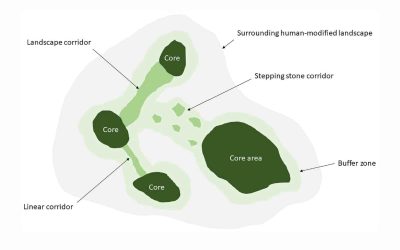
Looking out across large-scale wildlife corridor in Africa. Credit: Endangered Wildlife Trust.Endangered Wildlife Trust, a longstanding Alliance Partner located in South Africa, operating throughout Southern and Eastern Africa, have been paving the way for large-scale...
Global alternatives of natural vegetation cover
Preserving and restoring terrestrial ecosystems is essential to preventing the decline of life on Earth. To guide global conservation efforts, this paper presents a detailed counterfactual map showing Earth’s natural tree, short vegetation, and bare ground cover. This...
Semi-wild horse grazing as a rewilding strategy: assessing effects on vegetation structure and composition in the Côa Valley, Portugal
This study explores the early effects, over a three-year period, of a transition from extensive commercial cattle grazing to semi-wild horse grazing in two rewilding areas in the Côa Valley region, Portugal. Using grazing exclusion areas as control, the study tests...
The Deer and the Tiger, the Forest and the Carbon
In this invited commentary, Schmitz reviews the newly published research in Global Change Biology. Schmitz comments that Roberts et al. (2025) address this formidable challenge to reveal how varying abundance and outright loss of a large predator—the tiger (Panthera...
Global Tiger Density Linked With Forest Carbon Stock, Top-Down and Bottom-Up
Globally, forests with tigers living within them store more vegetation carbon than forests without tigers, near consistently across forest habitat types. Our results also showed that in disturbed forests, tigers appear to exert top-down control of carbon stocks...
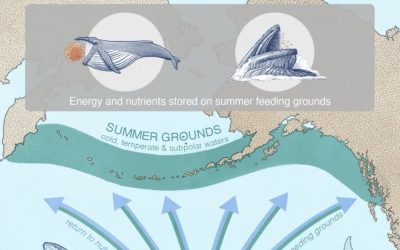
Migrating baleen whales transport high-latitude nutrients to tropical and subtropical ecosystems
This study brings key additional evidence to show that the recovery of whale populations will increase the resilience and adaptive capacity of oceanic ecosystems around the globe. The study looked at humpback, grey and right whales and how they feed over vast areas...
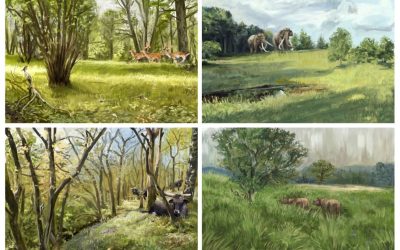
Beyond the closed-forest paradigm: Cross-scale vegetation structure in temperate Europe before the late-Quaternary megafauna extinctions
The study challenges the long-standing assumption that Europe’s temperate landscapes were uniformly covered by closed forest before human impact. They use pollen analyses to reconstruct vegetation patterns from the Last Interglacial and uncover a highly heterogeneous...
Quantifying the impacts of rewilding on ecosystem resilience to disturbances: A global meta-analysis
A meta-analysis to explore whether rewilding aimed at increasing biodiversity, disturbance stochasticity or connectivity increase ecosystem resilience. Rewilding generally enhances resilience with nearly 70% of observations reporting positive outcomes, 10% neutral and...
Intertwined people-nature relations are central to nature-based adaptation to climate change
Fabien Quétier, Head of Landscapes at Rewilding Europe, has co-authored another important study that, in his words "Highlights the importance of understanding and integrating social, ecological, and social-ecological relations in climate change adaptation, revealing...
Shifting baselines and the forgotten giants: integrating megafauna into plant community ecology
This paper, focussing mainly on plants, shows how large herbivores directly impact ecosystem diversity and functionality through changes to selection, speciation, drift and dispersal.
Realising the potential of a circular economy for wood-based materials
This briefing paper aims to clarify and elevate the role of wood-based materials and regenerative forestry in a circular economy. As users of wood-based materials, the co-project participants evaluate current forestry practices and the opportunities of regenerative...
Toward the quantification of the climate co-benefits of invasive mammal eradication on islands: a scalable framework for restoration monitoring
Islands are currently hotspots of biological and cultural diversity but face threats from invasive species and climate change. Invasive mammal eradication on islands is a proven conservation intervention that helps reduce biodiversity loss.
Substantial light woodland and open vegetation characterized the temperate forest biome before Homo sapiens
The extent of vegetation openness in past European landscapes is widely debated. In particular, the temperate forest biome has traditionally been defined as dense, closed-canopy forest; however, some argue that large herbivores maintained greater openness or even...
Megaherbivores provide biotic resistance against alien plant dominance
While human-driven biological invasions are rapidly spreading, finding scalable and effective control methods poses an unresolved challenge. Here, the authors assess whether megaherbivores—herbivores reaching ≥1,000 kg of body mass—offer a nature-based solution to...
Impacts of large herbivores on terrestrial ecosystems
Large herbivores play unique ecological roles and are disproportionately imperiled by human activity. As many wild populations dwindle towards extinction, and as interest grows in restoring lost biodiversity, research on large herbivores and their ecological impacts...
Tracking the global application of conservation translocation and social attraction to reverse seabird declines
This study addresses this gap for conservation decision makers responsible for seabirds and coastal management. We systematically reviewed active seabird restoration projects worldwide and collated results into a publicly accessible Seabird Restoration Database.
Ecological restoration for sustainable development in China
Research suggests that there existed local win−win synergies between ecosystem health and sustainable livelihoods and/or socioeconomic development. However, the identification of such win−win solutions for regional policymaking is still in progress, as benefits and...
Harnessing island–ocean connections to maximize marine benefits of island conservation
Eradication of invasive mammals and restoration of native biota are promising tools to address both island and ocean management goals. The magnitude of the marine benefits of island restoration, however, is unlikely to be consistent across the globe. We propose a list...
Ecological Protection and Livelihood Improvement in Ecologically Vulnerable Regions
The conflicts between protection and development are understood as the conflicts between ecological systems and social systems through dynamic land transitions such as land use (human control) and land cover (biophysical control).
Assessment of Seabird Restoration Priorities for the U.S. Pacific Islands
Conservation priorities for non-federally listed seabirds breeding within the U.S. Pacific Islands (USPI), with a focus on seabird colony restoration using social attraction and translocation. It covers five distinct geographic regions: the Main Hawaiian Islands...
“Nature’s contributions to people” and peoples’ moral obligations to nature
This paper argues that far from being half of an unhelpful dichotomy, intrinsic natural values are incontrovertible elements of any honest effort to sustain Earth's biodiversity. The "good life" they support is a good life for humans, and not for nonhuman beings or...
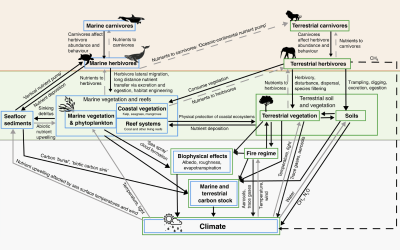
The role of large wild animals in climate change mitigation and adaptation
Two major environmental challenges of our time are responding to climate change and reversing biodiversity decline. Interventions that simultaneously tackle both challenges are highly desirable. To date, most studies aiming to find synergistic interventions for these...
Seabird meta-Population Viability Model (mPVA) methods
The seabird meta-population viability model (mPVA) projects population trends and extinction risk for 102 seabird species under different conservation scenarios. It uses a stage-structured matrix model accounting for breeding island features, dispersal, and spatial...
Where Might We Find Ecologically Intact Communities?
Conservation efforts should target the few remaining areas of the world that represent outstanding examples of ecological integrity and aim to restore ecological integrity to much broader areas with intact habitat and minimal species loss.
The use of social attraction techniques to restore seabird colonies on Desecheo Island, Puerto Rico
Desecheo Island, once a key seabird habitat in the Caribbean, saw major declines due to invasive mammals and past military use. Conservation efforts began in 1976, leading to the eradication of goats, macaques, and rats by 2016. In 2018, social attraction methods...
Guiding Principles for Rewilding
There has been much recent interest in the concept of rewilding as a tool for nature conservation, but also confusion over the idea, which has limited its utility. The authors of this paper developed a unifying definition and 10 guiding principles for rewilding...
Ecological restoration of agricultural land can improve its contribution to economic development
Landscape-scale ecological restoration of agricultural land can potentially increase the contribution of this land to economic development and employment, by increasing flows of all ES other than those associated with agricultural production. The evidence provided by...
Seabird Restoration Database website
Thanks to the generous support from the Packard Marine Bird Program, the Seabird Restoration Database was developed as the first conservation database of its kind, documenting global efforts to restore seabirds using active restoration techniques. Between 2020 and...
Restoring natural forests is the best way to remove atmospheric carbon
Plans to triple the area of plantations will not meet 1.5 degree climate goals. New and restored natural forests can help remove atmospheric carbon and lock it up within ecosystems in a safe and affordable way. (This article is behind a paywall)
Globally important islands where eradicating invasive mammals will benefit highly threatened vertebrates
Eradicating invasive mammals from islands is a feasible and proven approach to prevent biodiversity loss. We developed a conceptual framework to identify globally important islands for invasive mammal eradications to prevent imminent extinctions of highly threatened...
Effects of gray wolf-induced trophic cascades on ecosystem carbon cycling
It is predicted that predator-induced trophic cascades could have important impacts on ecosystem carbon cycling. Yet the magnitude and direction of predator impacts on carbon cycling have not been widely quantified until now.